
Twombly Cyclecar
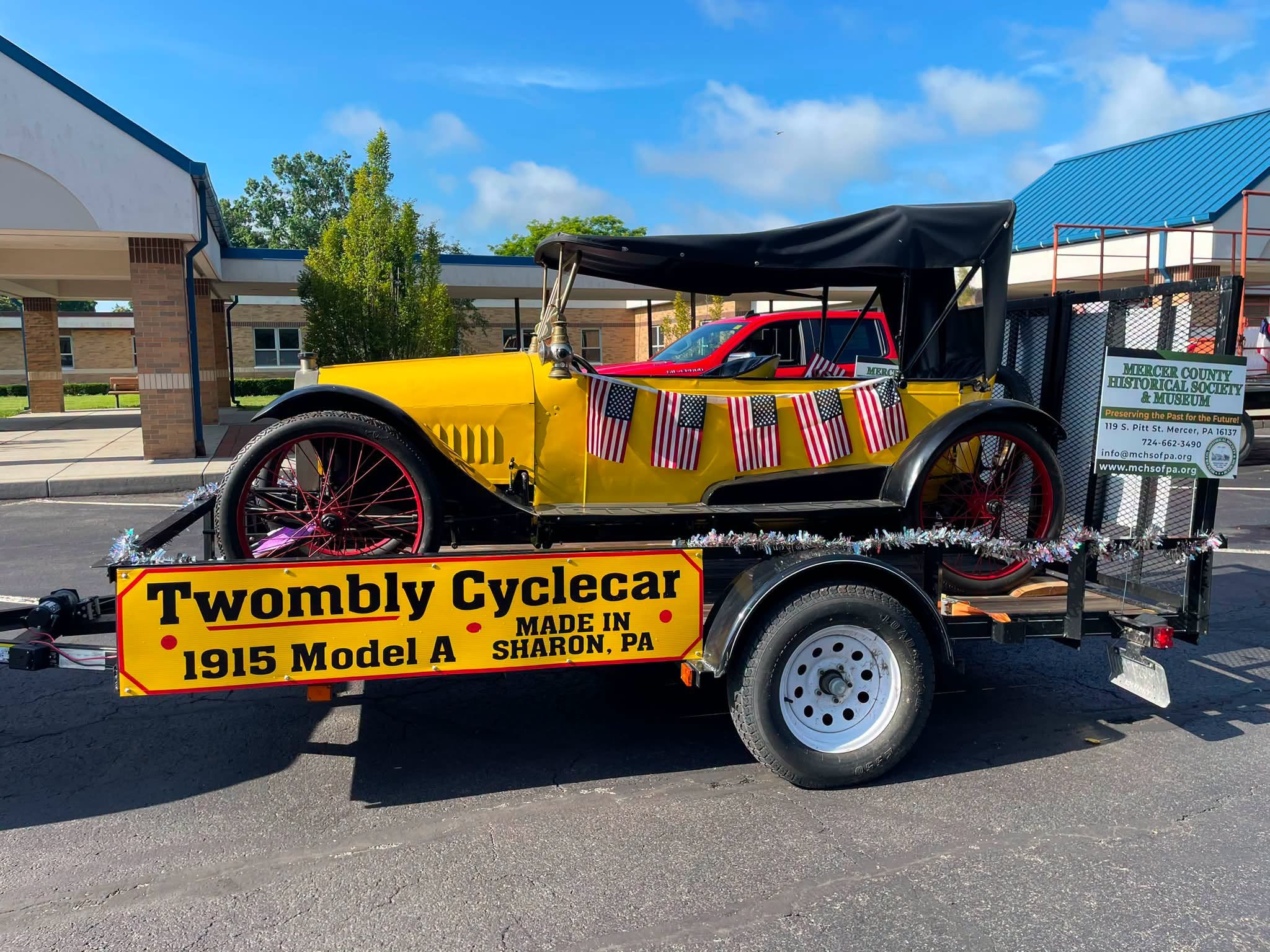
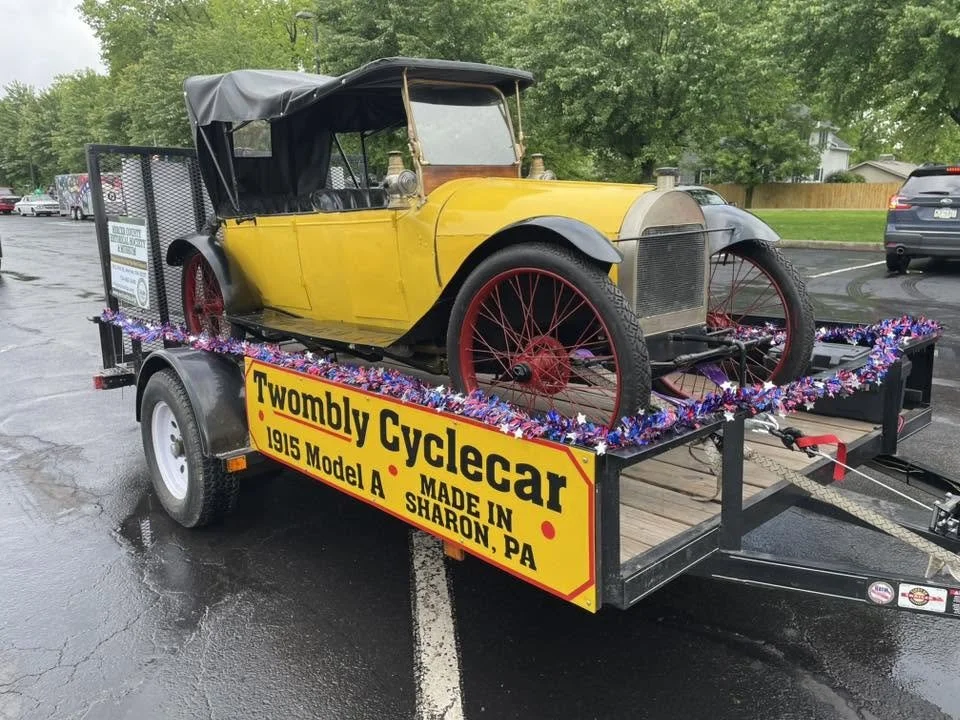
Stored at the Rural Life Museum at Munnell Run Farm in Mercer, PA is our RARE 1915 Model A Twombly Cyclecar!
*There are only 3 Twombly Cyclecars known to still exist.
Our 1915 Model A, made in Sharon, PA.
A 1914 stored at the Smithsonian that is not refurbished and not on display.
A 1914 in Australia.
What is a Cyclecar?
During the early decades of the 1900’s, automobile manufacturing exploded across the United States. Hundreds of different makes came into existence. Farmers, blacksmiths, and various industrial facilities tinkered with their own designs. Most of these only produced one to a dozen vehicles and then returned to their more familiar vocations.
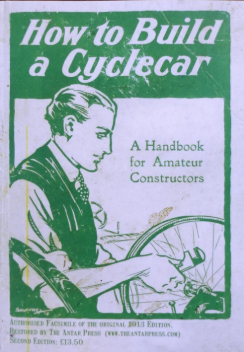
The Cyclecar was a design that emerged from the inspiration of the earlier developed “voiturettes”- small, lightweight cars. The Cyclecar can be described as a cross between a motorcycle and a car. They were small, lightweight, and inexpensive. Most were three or four wheeled, having low powered engines, and usually featuring only two seats in tandem. They were popular from the 1910s-1920s. There was even a handbook written and illustrated by Stanley Pontlarge that one could buy to learn to build their own.
A New York entrepreneur, Willard Irving Twombly, had tried unsuccessfully to manufacture his Cyclecar designs in 1904 and again in 1910. Convinced the third time would be the charm, he obtained financial backing and in 1912 approached the Driggs - Seabury Ordnance Company in Sharon, PA about producing his line of compact Twombly cyclecars.
At that time, the Driggs-Seabury Ordnance Company was a manufacturer of small, rapid-fire guns for military use. The company President, John Stevenson, Jr. had been seeking to add a new product to their manufacturing line and so a deal was struck. The Twombly Cyclecar was produced in Sharon, PA from 1913-1915 by the Driggs-Seabury Ordnance Company.
Trouble soon came. With only about half of his initial three thousand car order completed, Twombly’s main financial backer, the Rev. Dr. Dodge, pulled out of their business arrangement, claiming to be owed $468,238. Twombly was forced into bankruptcy.
Driggs-Seabury ended up owning the vehicle tooling and mechanical stock. They attempted various versions of the Twombly, branded as Driggs, Sharon, and Sharon Light Delivery. They also made prototypes of a more conventional roadster called the Ritz. Additionally, they produced Vulcan brand commercial truck chassis in a joint effort with the Springfield Company of Painesville, OH.
However, near the end of 1915, the interest in cyclecars was waning, and the war in Europe was gaining momentum. Driggs-Seabury needed the manpower and plant space put back to ordnance productions, and so automotive work ceased.
By the end of WWI, Driggs-Seabury had merged with Savage Arms of Utica, NY. And so, the Sharon, PA plant started making rifle barrels for the Savage line of sporting arms. Savage then bought out the J. Stevens Arms Company and moved all operations to New York State and the Sharon, PA plant was sold to Westinghouse Electric Corporation. Westinghouse produced transformers there until 1983. The property is now owned by Winner Steel.
As for Willard Irving Twombly, around 1925, he became involved in an expensive divorce case and was eventually jailed for a year following a conviction of wife abandonment. However, during his sentence, he worked on plans for a factory to produce his inventions and when paroled, he became vice president of a factory backed by Jackson, Michigan businessmen.
Cyclecar enthusiasm still lives. A quick search on the internet reveals even more interesting history. There is even an online magazine devoted to all things cyclecar related.
SPECIFICATIONS: (As Advertised)
Motor- Twombly type “A” cast en bloc. Four- Cycle, water cooler, thermos-syphon system; mechanical valves, positive oiling, 15 horsepower
Transmission - Twombly Friction - type with two- speed drive shaft and single chain drive to rear axle, six speeds forward-two reverse.
Rear Axle - Twombly live, unbreakable type, solid shaft from wheel to wheel with differential casing operating as emergency brake.
Front Axle - Drop-forged I- bean section, chrome nickel steel.
Wheels- Extra heavy wire, fitted with a 28” x 2 1/2” extra heavy clincher tires; non-skid rear, corrugated front.
Tread - 38”
Frame- Pressed steel, channel section
Spring System - 37” cantilever rear; 30” semi-elliptic front.
Wheelbase - 100”
Wheel Width - 41”
Height - 39” Chassis and 55” Windshield
Speed - 50 MPH
Gasoline Consumption - 40 MPG
Weight - 700 lbs (approximate)
Standard Equipment - Two side lamps, tail lamp, horn, and tools
Seating - 22 ½ “ tandem seats
The Mercer County Historical Society became the owner of this 1915 Model A Twombly Cyclecar in the summer of 2006. The car was built in Sharon, PA and it a two passenger, tandem seat, chain drive vehicle, known as a cyclecar.
The Joe Shafran Oral History Project worked for over a year to acquire the funds necessary to secure this piece of local history. The vehicle was then donated to the MCHS and became part of its collection of Mercer County artifacts. Shafran (decd.), who was a Sharon native and former local radio and television broadcaster, launched the local project in the early 2000’s to record Mercer County's oral history. Its recordings are housed at the Mercer County Historical Society in Mercer.
Notable mentions in this project:
George Wm. Morgan- Freedom, PA, former owner of the Twombly
Al DeBonis - Project fundraiser
Virginia Shank - Project assistant
Edward P. Bailey, Jr. -Historic Interpretation and fundraising
Frank Draskovic - Transportation and fundraising
Ray and Nancy Babos - Restoration of the Twombly
Sources:
MCHS 1915 Twombly Brochure (Twombly History by Edward P. Bailey, Jr.)
Twombley Cos. Bankrupt, The New York Time <104640883.pdf>
Prominent Inventor Again Put in Jail on Charges of Wife, The Daily News - Luddington, Michigan <Ludington Daily News - Google News Archive Search>